OROldRestore Pro
Use cases · Evidence field guide

Four restoration scenarios. Four review standards.

From inherited family prints to client delivery, each scenario is paired with real evidence showing who it serves, what damage must be addressed, and what should be confirmed before handoff.

Scenario evidence

Start with the use case, then judge the restoration.

01

Family memories

For family albums, memorial portraits, and inherited prints where identity matters more than aggressive sharpness.

Family albumsPortraitsIdentity-first
Real restoration evidence
Family memories · BeforeBeforeFamily memories · AfterAfter
Surface damage is reduced while the printed border, composition, and recognizable family features remain visible.

Who it servesFamilies preserving albums, portraits, memorial photographs, and images passed between generations.

Source damageFading, stains, scratches, creases, and surface wear hide facial cues and weaken the original print.

Review outcomeFaces still feel familiar, the original border and period texture remain natural, and the image is ready for a final large-view check.

Read the related restoration guide
02

Graduation and group photos

For class photographs, reunions, teams, and large groups where clarity must improve without rearranging the scene.

GraduationClass photosMany faces
Real restoration evidence
Graduation and group photos · BeforeBeforeGraduation and group photos · AfterAfter
A real graduation task shows conservative clarity recovery across a dense group without changing the composition.

Who it servesAlumni, schools, teams, and families restoring group photographs with many small faces.

Source damageSoft detail, glare, faded color, and weak local contrast reduce readability across rows of people.

Review outcomePeople count, pose, banner, crop, and relative positions stay stable while faces and clothing become easier to inspect.

Read the related restoration guide
03

Historical archives

For local-history collections, genealogy, and scanned documentary photographs that need a traceable, restrained restoration.

Local historyScansTraceable review
Real restoration evidence
Historical archives · BeforeBeforeHistorical archives · AfterAfter
Highlight recovery and local contrast make the group legible while retaining the original print structure.

Who it servesCommunity archives, researchers, family historians, and custodians digitizing documentary collections.

Source damageOverexposure, haze, low contrast, scan marks, and aging paper can obscure people and documentary detail.

Review outcomeThe source remains identifiable, period character is retained, and the restored result is readable enough for documented review.

Read the related restoration guide
04

Studios and restoration shops

For operators who need repeatable intake, evidence-based review, and quick access to the selected final file.

Client workTask recordsDelivery
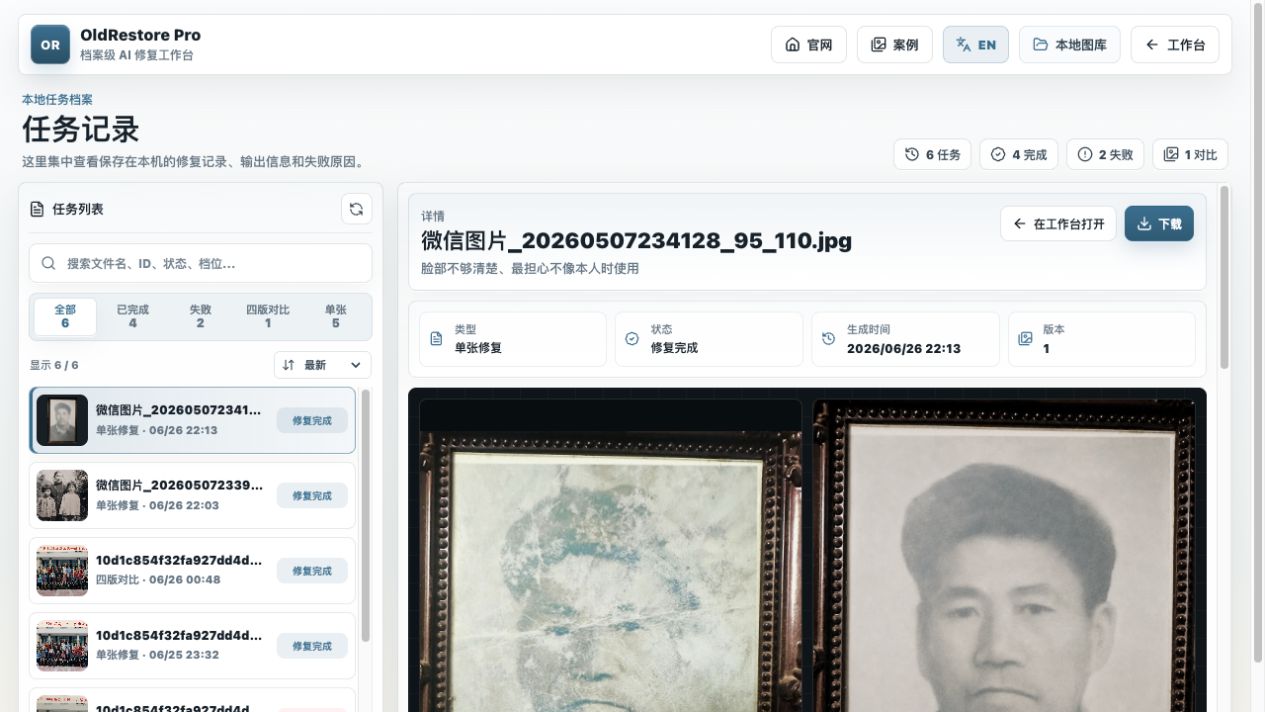
Real task record · source and result
Studios and restoration shops · Real task record · source and result
The real task-record view keeps source, restored result, task state, and delivery actions in one review surface.

Who it servesPhoto studios and restoration operators handling client work from source intake through final delivery.

Source damageEvery client image brings a different damage profile, while filenames, versions, and output decisions must remain easy to trace.

Review outcomeSource and result are reviewed together, the chosen output remains attached to its record, and the final file is ready to download or open locally.

Read the related restoration guide
Use your own source

Apply the right review standard to a real photograph.

Open the Studio, upload the source, and keep the original available through generation, review, and handoff.

Open Studio